Facebook Developer Circles · Nairobi
Running a 3,000-developer community as a volunteer, with a full-time job
- Role
- Community Lead
- Period
- 2018–2020
- Location
- Nairobi, Kenya
The problem
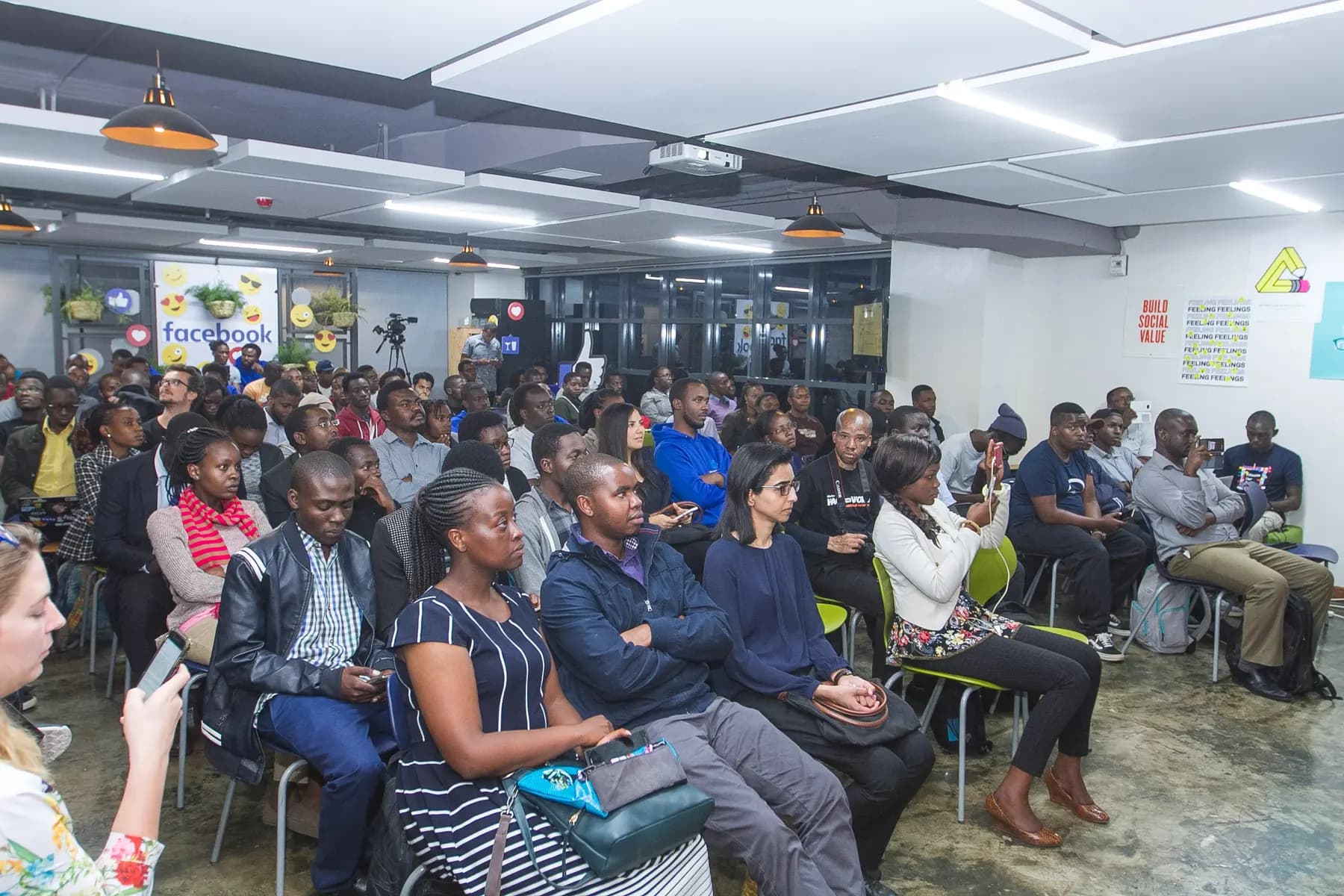
I had a community heading past 3,000 developers, a few hours a week, no ability to answer people individually, and a full-time engineering job.
Context
- Developer Circles was Facebook's global program for local developer communities. Facebook provided event budget, technologies and training materials; execution was local.
- I took over the Nairobi chapter from Anthony Nandaa and co-led it with Elsis Sitati and a team of volunteers. It did not start with me and it was never a solo effort.
- This was volunteer work, run alongside my role at VituMob.
- The constraint of no time and no headcount is what forced the systems thinking. There was no version of this that worked through effort.
How I approached it
- 01
Make growth self-serve
Members joined through events, word of mouth and referrals, then onboarded themselves into the Facebook Group where updates and resources lived. Reducing friction mattered more than a personal welcome. It made the community peer-driven instead of lead-driven.
- 02
Build repeatable formats, not one-off events
Happy Hour coding challenges and Bar Camp show-and-tell sessions ran on templates. Technical workshops covered React, Node and AMI. A repeatable format is a system; a great one-off event is a dependency on whoever ran it.
- 03
Distribute ownership deliberately
Clear roles, documented process instead of tribal knowledge, communication channels organised by topic, regular check-ins to surface problems early. The best community leads are not the ones doing everything. They are the ones who make it possible for everyone else to contribute.
- 04
Treat inclusion as programming, not as a statement
We recruited actively through women-focused groups, universities and bootcamps instead of waiting. We created smaller women-focused sessions before larger ones, featured women speakers and projects, and ran mentorship pairings. Representation was built into the format.
- 05
Measure, then act on it
Attendance by topic, engagement versus lurking, retention over time, diversity against goals, skill development, and whether membership actually led to opportunities. That data decided which events repeated and which partnerships were worth keeping.
What I did
- Grew and led the chapter to 3,000+ developers
- Delivered 30+ workshops and recurring technical programs
- Built onboarding, event templates and documentation that ran without the lead
- Ran women-in-tech recruitment, sessions and mentorship pairings
- Coordinated with Facebook's global community team and local partners
- Represented the chapter at F8 and at Meta HQ in Menlo Park
Result
3,000+
Developers in the community
30+
Workshops delivered
1,000+
Active participants
Community members went on to mentor at major events, win hackathons and publish. The chapter became known as one of the more inclusive Developer Circles in Africa.
What I took from it
- You cannot scale manually. At 50 members you can know everyone; at 3,000 the only thing that works is a system other people can run.
- Community leadership is operations work. Delivering on time, aligning volunteers, measuring outcomes, coordinating stakeholders. The label is different, the job is not.
- Volunteer work is real experience. It is often where the hardest coordination problems are, because you have no authority and no budget to fall back on.
- Ecosystem work compounds. This is the chapter that led directly to the next one.
From the community
Other work
Meta · Dublin
Operating between developers and everything that had to move for them
VituMob · Nairobi
Taking over a production system in a language I did not write
If any of this is the shape of a problem you have, I'd like to hear about it.